

Gimme Gimme Molas
Barefoot, buzzed and buying textiles in the San Blas islands


As I squinted in the intense Caribbean sunlight, I had the distinct feeling that I’d been transported to a parallel universe.
Maybe it was the Dramamine hangover from a stomach-churning early morning 4x4 drive from Panama City to the Carti pier, where we were wordlessly herded onto a weathered longboat for the cruise to Isla Aroma, a dime-sized island in the San Blas Archipelago and our home for the next 3 nights.
Or maybe it was the way we stumbled onto the dock at Isla Aroma, sea legs still shaky, and were shown to our room - and by room, I mean tiny tiki hut, with its palm thatched roof and sand-covered floor, that didn’t even have a lock on the door. Our only instructions from our guide? Drop your things, and be back on the boat in 15 minutes.
Or maybe it was the unannounced detour that our captain - El Capitán - had made en route to lunch: he pulled up to an unmarked dock, where without a word he handed a teenage boy a $20 in exchange for a bottle of Ron Abuelo, Panama’s premium rum.
By the time we were deposited on the shores of another practically-deserted island and left to our own devices, I felt like I’d been shipwrecked on the set of Gilligan’s Island.
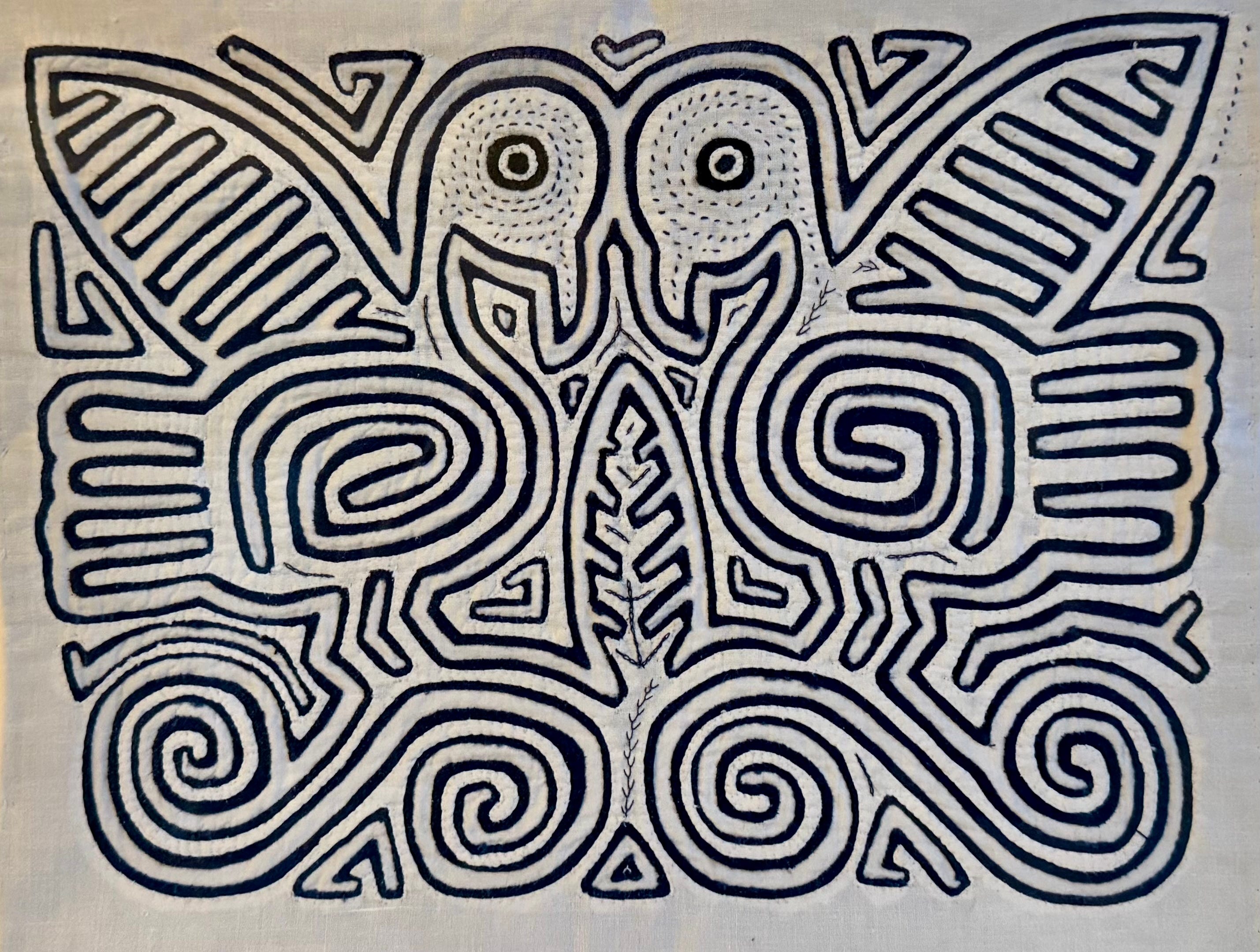
There were swimmers in the distance, diving for starfish; a sunburned bro silently sipping a Balboa, so relaxed that he seemed practically catatonic; and a pair of Guna women sitting in the shade, sewing molas, the brightly colored, reverse appliquéd cloth panels traditionally worn by indigenous women.
More molas fluttered in the breeze on a clothesline stretched between two palm trees, with price tags handwritten on scraps of notebook paper. I was entranced by their bright colors - neon oranges, fiery reds, electric pinks - and bold, graphic lines that jumped off of the cloth. I ran my fingers over the raw, unfinished edges - molas are often sewn into shirts - and traced the raised appliqué patterns, marveling at the precision of each and every stitch.
The geometric patterns somehow felt both ancient and contemporary at the same time, and I would later learn that these spiritual undertones weren’t just in my imagination. In fact, scholars believe that molas build upon a centuries-old tradition of body painting, in which Guna women drew symbols and signs onto the bodies of their family members to ward off evil spirits.
This practice of adorning one’s body with sacred talismans has been fiercely protected by the Guna people throughout their history: in fact, in 1925, the leaders of the San Blas Rebellion held strong in the face of calls from the Panamanian government to assimilate by giving up traditional garments.
Today, the art of mola making is still passed down from mother to daughter (as are property and land rights - the Guna are a matriarchal society) and is an integral symbol of Guna identity.
I knew that I couldn’t leave San Blas without a mola, but at the same time, the nearest ATM was on the mainland and our cash needed to stretch until the end of our stay. My sister would never let me live it down if I blew our meager budget on textiles on our very first day (or god forbid, stood between her and a catch-of-the-day lobster dinner). Regretfully, I wandered back to my sister and tried to put my favorite mola - a pair of tropical birds stitched in navy on a white ground - out of my mind.
We spent the next few days in a blissful blur: being woken up each morning by a conch shell in lieu of an alarm clock, island hopping and beach bumming, snorkeling near shipwrecks, partying day and night with our newfound crew of fellow castaways, drinking $1 Balboas and shots of Ron Abuelo, courtesy of El Capitán.
I had almost forgotten about my mola until, on our last day, we pulled up to the dock at that same no-name island from day one. And luck was on my side: I had enough cash left to cover our afternoon bar tab and a pair of molas.
As El Capitán herded us back towards the boat - we had one more stop to make at a sand bar before heading for the mainland - it was time to make my move. Still barefoot - I hadn’t worn shoes in days - and buzzed after a boozy lunch, I doubled back to the clothesline, pointed and murmured a few words of broken Spanish to the Guna women, and handed over the last of my cash. When I met my sister at the boat, I was triumphant. She rolled her eyes.
When I took my molas to the framer years later, I couldn’t help but notice that the cloth was still dusted with fine grains of sand. And though I truly detest having sand in my home - I couldn’t bring myself to brush it away.
Thank you for taking me on a mini-vacation while I sip my morning coffee in St. Louis. The adventure sounds divine!