

A Grand Tour of European Chandeliers
Styles, search terms & my own wish list of baubles from Austria, France & Italy

I’ll never forget my first evening in Vienna: I was fresh off the train from Timişoara, bundled up in the early January chill, and walking the Ringstrasse at dusk, feeling intoxicated by the glittering chandeliers that I glimpsed in what felt like every window I passed. It was all impossibly glamorous, especially for a broke college student who had opted to stay at a monastery guesthouse rather than a proper hotel, all in the name of saving a few euros.
Fast forward a few years, and my chandelier obsession has only intensified. The warning signs were there when, three years ago, I dragged my sister through the Marais to bring home a petite chandelier Christmas ornament. They were impossible to ignore last fall, when I insisted on hauling an Empire-style basket chandelier home from Paris in my carry-on.
And, according to my family, I was in need of an intervention by the time I won an early 20th-century Bohemian glass chandelier at auction earlier this year. (Please don’t tell them I’m also currently eyeing an Italian gilt tôle wheat sheaf fixture, inspired by designs in Coco Chanel’s Paris apartment.)
Unfortunately for me, I’m running out of light fixtures that I can upgrade in my own home. But fortunately for you, that means that today I’m sharing my secrets for sourcing chandeliers: styles to look for, search terms to source your own, and my own personal, no-expense-spared wish list.
Austria 🇦🇹
Uncouth though it may be, spit in Vienna’s historic city center and you’re bound to hit a chandelier. Exhibits A, B and C: the imperial 72-candle wooden gilt chandeliers in the Great Gallery at Schönbrunn Palace; the crystal chandeliers at the Spanish Riding School; and Josef Hoffmann’s Jugendstil design for the Werkbund Exhibition in Cologne in 1914, among many (many!) others.
The glassmaker that’s been there through it all? J. & L. Lobmeyr, a heritage brand founded in 1823 by Joseph Lobmeyr and still run by Lobmeyr’s descendants 6 generations later.
Lobmeyr produced its first chandelier in 1840 for the Austrian Embassy in St. Petersburg and has been accepting prestigious international commissions ever since - including the reconstruction of the Vienna State Opera House after World War II, the Metropolitan Opera House in New York City, the Kremlin in Moscow, and the Al-Masjid al-Haram mosque in Mecca.
To source your own Austrian-inspired designs, use search terms like:
General search terms: Lobmeyr, Austrian crystal, Austro-Hungarian chandelier
For old world, imperial vibes: Maria Theresa, Habsburg crystal, Biedermeier, Austrian Empire-style
For art nouveau, Secession-style: Jugendstil, Wiener Werkstätte, Josef Hoffmann, Otto Wagner, Koloman Moser
For mid-century modern masterpieces: Mid-century modern, MCM, Hans Harald Rath, Bakalowits & Söhne
On my wish list:
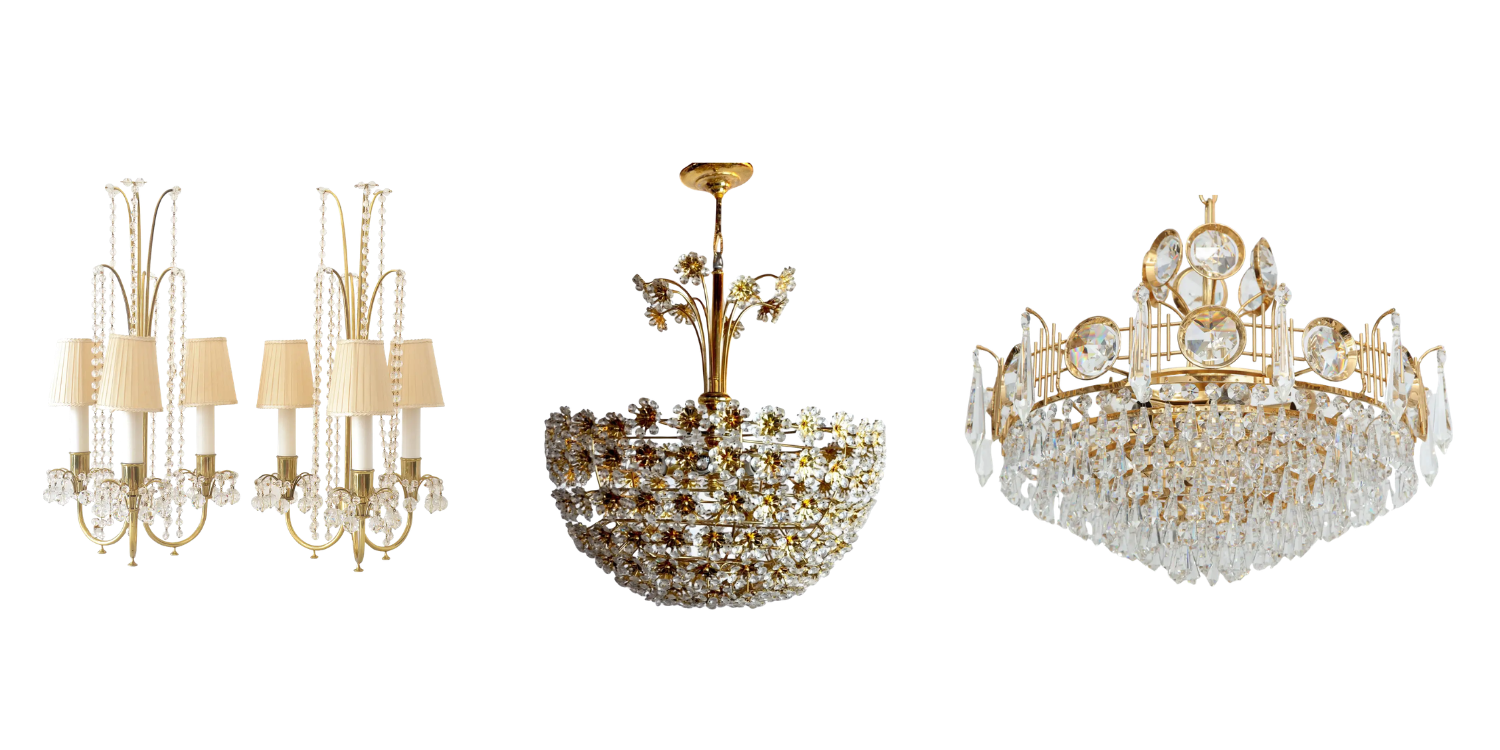
A pair of chandelier-ish table lamps at a relatively accessible price point, a charming bowl-style chandelier adorned with crystal flowers, and a 1970s chandelier that somehow channels both Art Deco and MCM styles.
France 🇫🇷
Is there a light fixture more quintessentially French than the chandelier (which is derived from the Old French word chandelle, meaning “candle”)?
Though I could wax poetic pour l’éternité about the merits of niche French chandelier styles, for the sake of expediency we’ll focus today’s lesson on three of the most notable ones.
Rococo, a frothy, flirtatious style that peaked in the mid-18th century during the reign of Louis XV (1715-1774). With its swirling gilded curves, shell motifs, and organic lines, Rococo styles offered a lighter, freer alternative to the heavier grandeur of the Baroque designs that preceded them.
Empire, a return to Neoclassicism that took hold in the early 19th century. Empire-style chandeliers are defined by a strong sense of symmetry, classical ornamentation (think laurel wreaths, sphinxes, and lions, among others), and an air of Napoleonic pomp.
Art Deco, a sleek, modern style that became popular in the 1920s. Art Deco chandeliers are defined by their restraint: think streamlined geometric forms, striking materiality with high-contrast glass and metal, and graphic motifs like sunbursts and chevrons.
To source your own French-inspired fixtures, use search terms like:
For Rococo-style froth: French Rococo, Louis XV, Louis XV revival, Louis quinze, giltwood, bronze doré, ormolu
For Empire-style formality: French Empire, Napoleonic, ormolu, bronze doré, basket chandelier, montgolfière
For Art Deco-style restraint: French Art Deco, 1920s, French Modernist, Degué, Muller Frères, Marius-Ernest Sabino, Atelier Petitot, René Lalique, Georges Leleu
On my wish list:
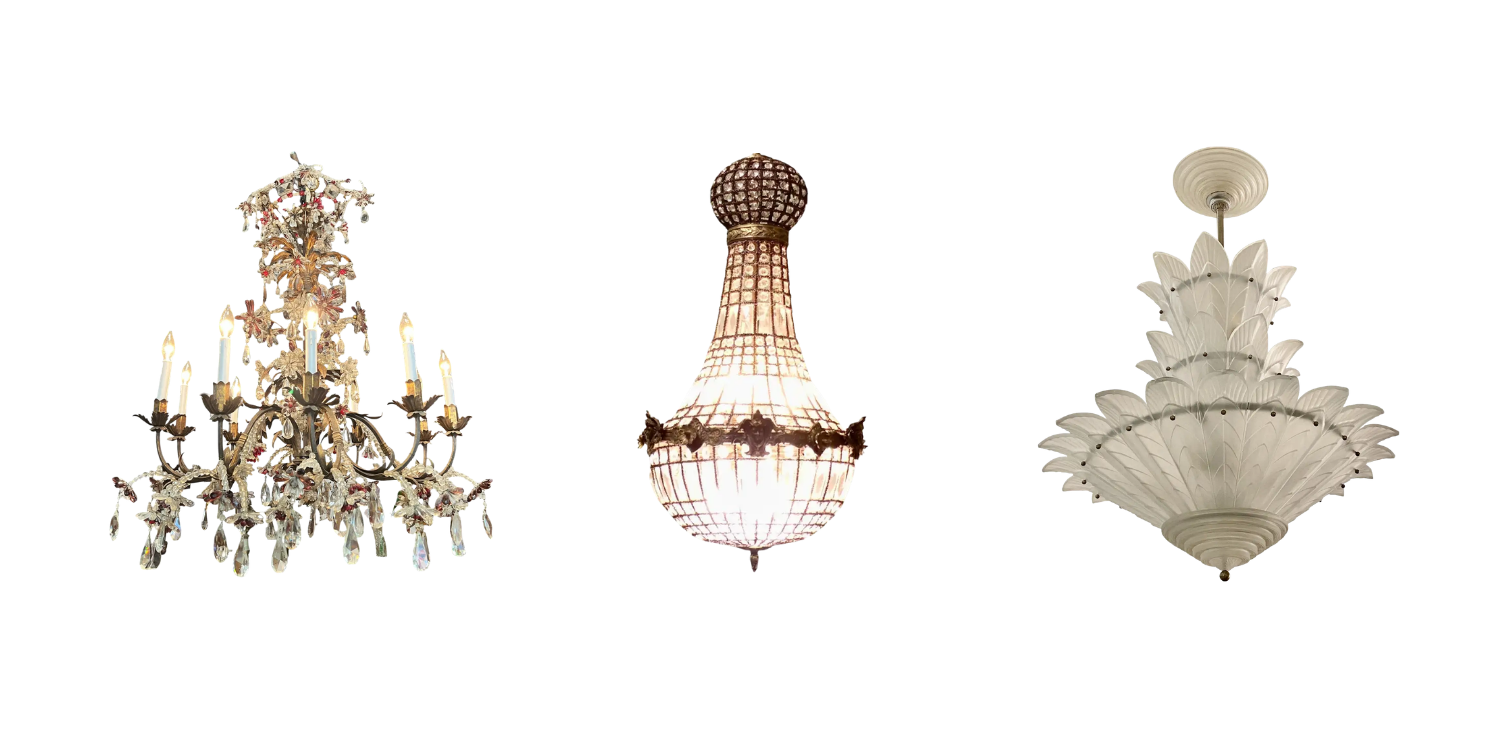
A Rococo revival-style concoction complete with glittering amethyst and crimson accents; an Empire-style “montgolfière (balloon)” chandelier, a more streamlined take on the basket chandelier silhouette; and the splurgiest-splurge, a six-figure, three-tiered masterpiece signed by Monsieur Sabino himself. A girl can dream, eh?
Italy 🇮🇹
I’ll be brutally honest: chandeliers were decidedly not on my mind on my most recent trip to Italy, when we spent 3 nights in the Italian alps hiking hut-to-hut along the 105 mile Tour du Mont Blanc. In my defense, after hiking all day I was more focused on where my next Aperol spritz was coming from.
Regrettably, I wasn’t able to haul a sputnik chandelier home in my backpack on the trek from Courmayeur. But fortunately, I didn’t have to: iconic Italian lighting styles are easily accessible on the antique circuit (in fact, I did score a pair of Murano sconces for a pittance from the Portobello Road market in London). Here are my own personal favorite stili italiani.
Murano glass, the product of a style of glassblowing that has been practiced in the Veneto region for more than a thousand years (though chandeliers were not broadly produced until the 18th century). Styles range from ethereal to full-on theatrical, with swirling organic lines and an extraordinary range of colors.
Tôleware, a style that first gained popularity in the late 18th century, and that is defined by its materials. Artisans lacquered, painted and gilded sheets of tôle (French for tin), which they then crafted into fanciful shapes: lemons, flowers, and wheat sheaves are all associated with Italian tôleware traditions today.
Sputnik style, a mainstay of the 20th century Italian modernism movement that took hold in postwar Milan. Gino Sarfatti, founder of Arteluce, pioneered the form - a space age-y burst of light, with brass arms that extend in every direction, as if from an exploding supernova - in 1939. The style would later be nicknamed “Sputnik” in the 1950s, after the eponymous Russian satellites first launched in 1957.
To source your own Italian-inspired chandeliers, use search terms like:
For curvy, translucent Murano masterpieces: Murano glass, Venetian glass, hand-blown glass, Italian art glass, Barovier & Toso, Venini, Mazzega
For always fanciful, sometimes fruity tôleware: Italian tôle, painted tôle, polychrome tôle, Hollywood Regency, Coco Chanel-style tôle, fruit tôle, 1960s/1970s tôle
For Space Age Sputnik styles: Italian sputnik, Gino Sarfatti, Arteluce, Italian modernist, atomic chandelier, Stilnovo, Sciolari
On my wishlist:
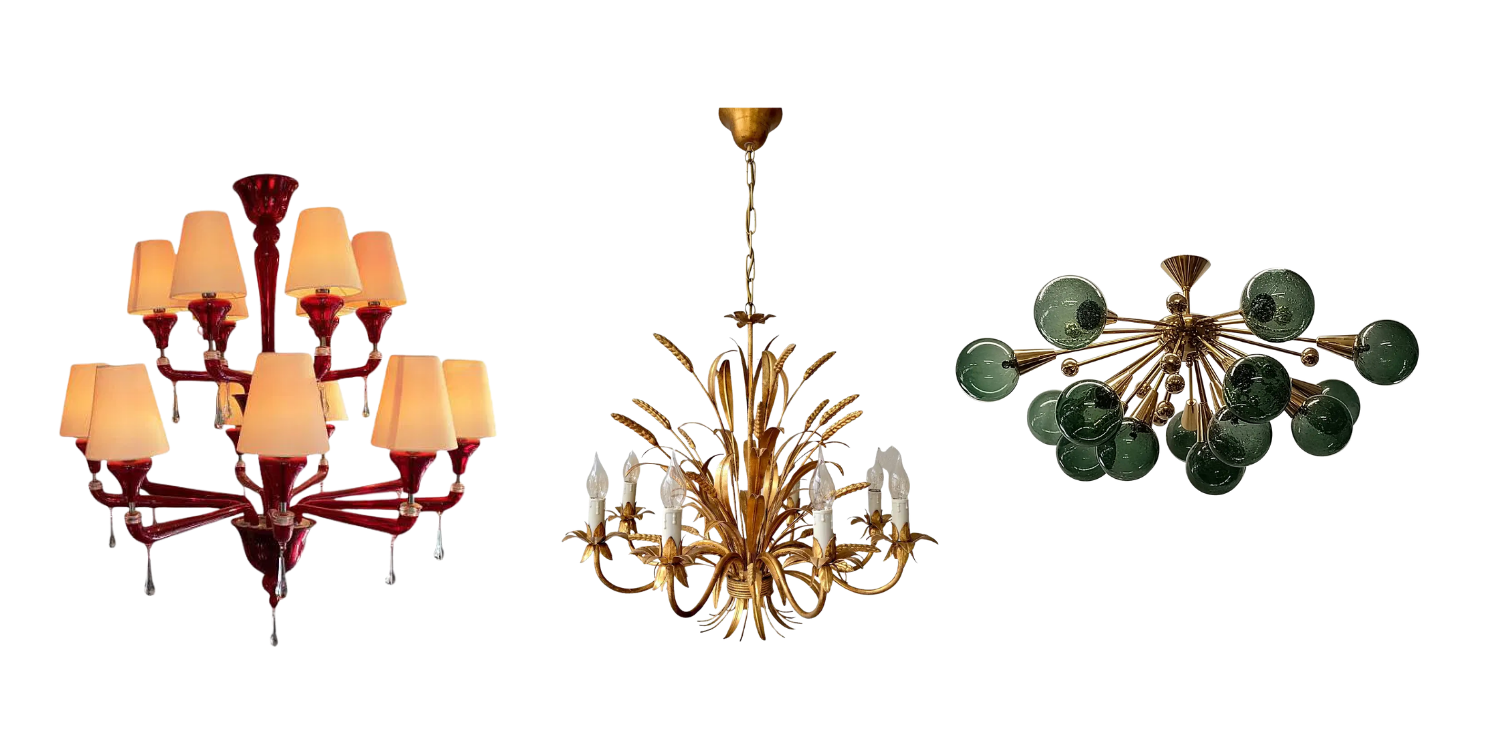
A theatrical, two-tiered glass confection that would be right at home on a Baz Luhrmann set; a gilded tôle wheat sheaf fixture that would glam up my dining room; and a sleek, futuristic design that feels straight out of The Jetsons.


These chandelier descriptions almost made me forget about the need for a lighting intervention. Lumière, from "Beauty And The Beast," would be proud of this post.